The Wise Men of Babylon
The four academic and occult offices Daniel entered
When Daniel and his companions were selected for royal training in Babylon, they were being inducted into one of the most sophisticated — and spiritually ambitious — intellectual establishments in the ancient world. Understanding who the Babylonian wise men were illuminates everything about what Daniel was asked to become, and what he refused.
What Daniel Was Entering
The institutional world behind Daniel 1:4
Daniel 1:4 specifies that the young men selected for royal training were to be taught "the literature and language of the Chaldeans." This was not merely a curriculum. It was an entire professional and spiritual world — a network of overlapping offices that together comprised the intellectual infrastructure of the Babylonian state.
The Babylonian court maintained four distinct classes of wise men, each with its own body of knowledge, its own texts, its own ritual functions, and its own relationship to the king. They were collectively designated hakamim — "wise men" — but the individual offices were carefully distinguished in the Hebrew and Aramaic of Daniel's own record.
"Then the king commanded Ashpenaz, his chief eunuch, to bring some of the people of Israel, both of the royal family and of the nobility, youths without blemish, of good appearance and skillful in all wisdom, endowed with knowledge, understanding learning, and competent to stand in the king's palace, and to teach them the literature and language of the Chaldeans."
Daniel 1:3–4
The phrase "competent to stand in the king's palace" is the point of entry. Daniel and his companions were not being trained as servants. They were being groomed for the highest advisory tier of the Babylonian administration — the circle of wise men who stood before the king himself. Understanding what that meant requires knowing who those men were.
The Babylonian wisdom tradition was inseparable from its religious claims. To be trained as a wise man was to be trained in a system that attributed knowledge of the future to omens, incantations, astronomical observation, and spirit contact. Daniel would emerge from this training ten times wiser than all of them — by the hand of the God the system did not acknowledge. The entire book of Daniel is, in part, a sustained contrast between two epistemologies: revealed knowledge and occult knowledge. Chapter 1 introduces the contest.
The Four Offices
Distinct roles with overlapping authority — all serving the king
The four offices were not simply different titles for the same function. Each represented a distinct body of knowledge, a distinct set of practices, and a distinct claim to access hidden reality. They overlapped in their service to the king, but their methods and specializations were carefully differentiated.
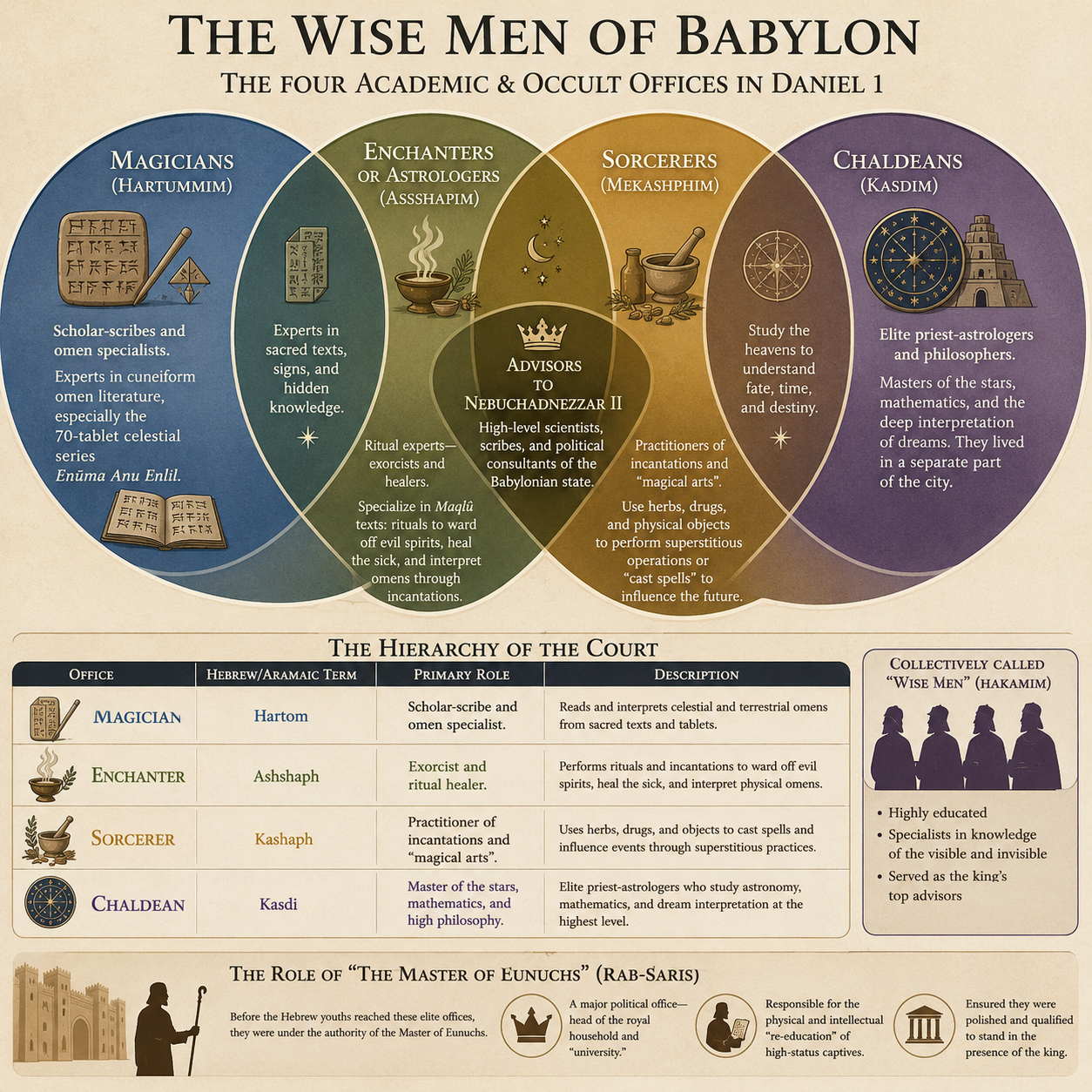
The Hierarchy of the Court
Hebrew and Aramaic terms, roles, and descriptions
| Office | Heb / Aram Term | Primary Role | Description |
|---|---|---|---|
|
Magician
|
Hartom | Scholar-scribe and omen specialist | Reads and interprets celestial and terrestrial omens from sacred texts and tablets. The institutional memory of the Babylonian knowledge tradition. |
|
Enchanter
|
Ashshaph | Exorcist and ritual healer | Performs rituals and incantations to ward off evil spirits, heal the sick, and interpret physical omens. The active responder to the omen world. |
|
Sorcerer
|
Kashaph | Practitioner of incantations and "magical arts" | Uses herbs, drugs, and objects to cast spells and influence events through superstitious practices. Works at the material-spiritual boundary. |
|
Chaldean
|
Kasdi | Master of the stars, mathematics, and high philosophy | Elite priest-astrologers who study astronomy, mathematics, and dream interpretation at the highest level. The philosophical and theological apex of the court. |
Every one of the four Babylonian offices corresponds to a practice explicitly prohibited in Deuteronomy 18:10–11 — the passage that forbids Israel from the divination, omens, sorcery, spells, and spirit-consultation of the surrounding nations. Daniel was trained in precisely the disciplines his law forbade. This is not incidental. It is the sharpest possible framing for the question the book asks: whose knowledge is real? When Nebuchadnezzar's entire wisdom establishment fails to reveal and interpret his dream, and Daniel does it in a single night by prayer, the epistemological contest is decided.
The Role of the Rab-Saris
"The Master of Eunuchs" — the gatekeeper between Daniel and the king
Before Daniel and his companions could reach any of the four offices, they passed through another institution entirely: the authority of the Rab-Saris, the Master of Eunuchs. This was not a minor administrative role. It was a major political office at the center of the palace's intellectual and social life.
"And the king spoke to Ashpenaz, his chief eunuch, to bring some of the people of Israel... Daniel resolved that he would not defile himself with the king's food, or with the wine that he drank. Therefore he asked the chief of the eunuchs to allow him not to defile himself."
Daniel 1:3, 8 — Ashpenaz is the Rab-Saris
Ashpenaz is named as Daniel's direct superior. He is the one Daniel negotiates the food test with. The relationship between them — respectful, strategically honest, ultimately productive — is one of the book's understated portrait moments. Ashpenaz cared what happened to Daniel. The text says he showed Daniel "steadfast love and mercy" (1:9).
The renaming of the four Hebrews is one of the most significant moments in chapter 1, and it happened under the Rab-Saris's authority. Daniel (God is my judge) → Belteshazzar (Bel protect his life). Hananiah (the LORD is gracious) → Shadrach. Mishael (who is what God is?) → Meshach. Azariah (the LORD has helped) → Abednego. Babylon tried to overwrite their identities at the level of their names. The rest of the book is the story of how thoroughly it failed.
Daniel's Placement in the System
Inside the machine — outside the epistemology
At the end of the three-year training period, Daniel and his companions are examined by Nebuchadnezzar himself. The verdict is unambiguous: in every matter of wisdom and understanding that the king inquired of them, he found them ten times better than all the magicians and enchanters in his whole kingdom (1:20).
What this means structurally: Daniel occupied the offices, spoke the language, read the literature — and was measured by the system's own highest standard. He was not an outsider offering an alternative. He was an insider who surpassed the system while drawing on something the system did not possess. The book tracks how that plays out across every subsequent crisis.
"And in every matter of wisdom and understanding about which the king inquired of them, he found them ten times better than all the magicians and enchanters that were in all his kingdom."
Daniel 1:20 — the verdict of the three-year training period
Ten times. The number is not casual. And it is not Daniel's training that produces it — the text is explicit that God gave Daniel and his companions knowledge and understanding, and to Daniel specifically, understanding in all visions and dreams (1:17). The wise men of Babylon had a system. Daniel had a source. The book of Daniel is the record of which one held.