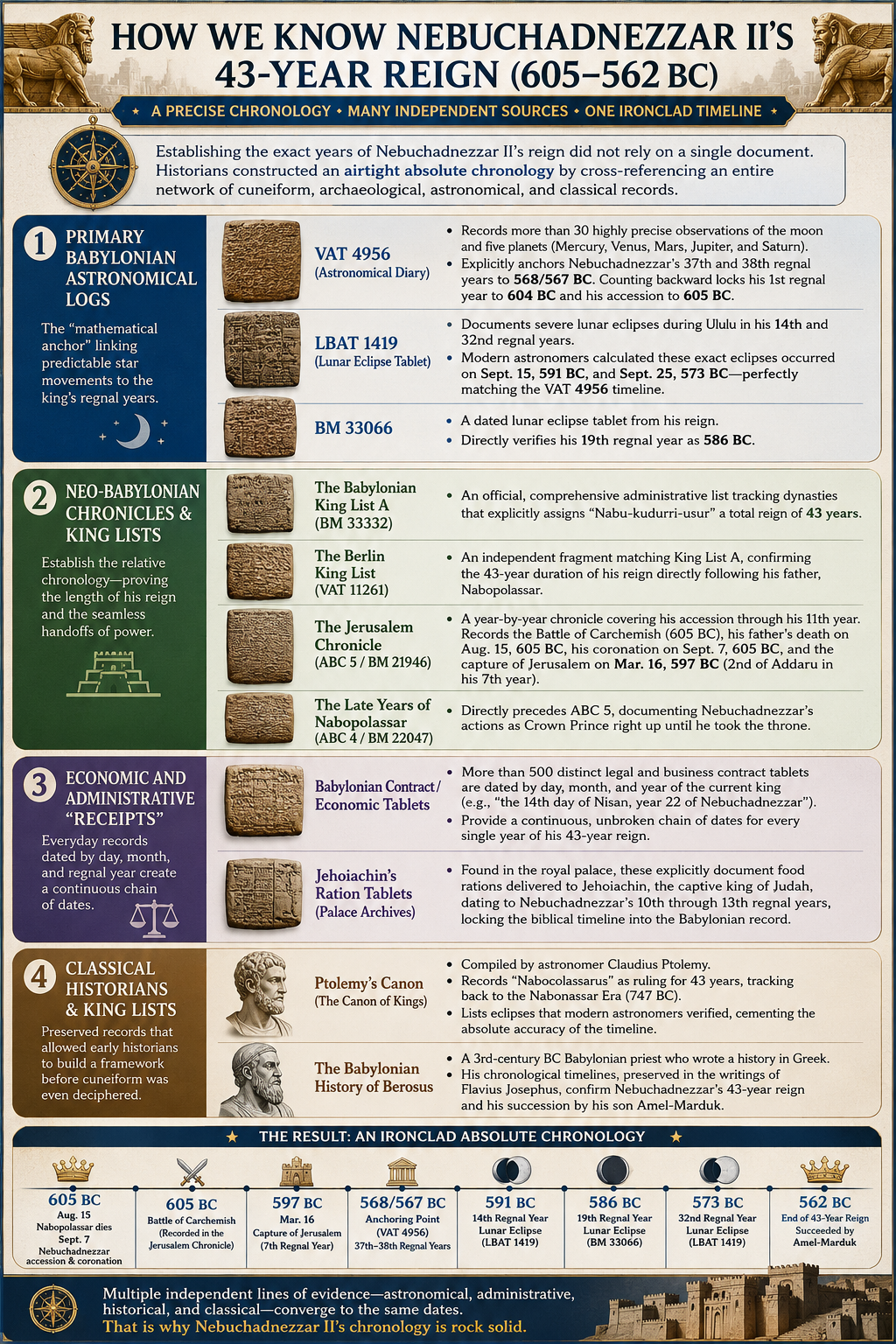
Nebuchadnezzar II · 605–562 BC · Four independent lines of evidence, one ironclad chronology
· · ·
Establishing the exact years of Nebuchadnezzar II's reign did not rely on a single document. Historians constructed an airtight absolute chronology by cross-referencing an entire network of cuneiform, archaeological, astronomical, and classical records. Four independent lines of evidence converge on the same dates.
Section I
Why This Matters for Daniel
The book of Daniel is anchored to datable historical events — and the anchors hold
The book of Daniel is one of the most chronologically specific books in the Old Testament. It dates events to the regnal years of specific kings: Nebuchadnezzar's first year, his second year, Belshazzar's third year, the first year of Darius the Mede. These are not vague historical references — they are precise anchors that either correspond to verifiable history or they don't.
They do. Nebuchadnezzar II's reign has been established to within days by four entirely independent lines of evidence — astronomical, administrative, chronicle-based, and classical. The chronology is not a matter of scholarly consensus built on fragile assumptions. It is a convergence of multiple self-checking systems that all arrive at the same result.
The Method: Cross-Reference, Not Assumption
Historians did not simply take Babylonian records at face value. Each line of evidence was checked against the others. Astronomical observations are independently verifiable — modern astronomers can calculate exactly when lunar eclipses occurred in the 6th century BC and confirm whether the ancient records match. When astronomical data, administrative records, chronicle lists, and classical historians all agree to within days, the chronology is not a theory. It is a measurement.
How historians established Nebuchadnezzar II's 43-year reign — four independent lines of evidence, one ironclad timeline
Astronomical Logs
Chronicles & King Lists
Administrative Records
Classical Historians
Section II
1
Primary Babylonian Astronomical Logs
The "mathematical anchor" — linking predictable star movements to the king's regnal years
The Babylonians were among the most meticulous astronomical observers in the ancient world. Their diaries recorded the positions of the moon and planets night by night, along with economic data and historical events — all dated to the regnal year of the reigning king. Because celestial mechanics are calculable with perfect precision, these records function as a two-way bridge: known astronomy dates the history, and known history dates the astronomy.
VAT 4956 — The Astronomical Diary
Vorderasiatisches Museum, Berlin
Primary Anchor
▾
The single most important astronomical document for anchoring Nebuchadnezzar's chronology. This diary records more than thirty highly precise observations of the moon and five planets — Mercury, Venus, Mars, Jupiter, and Saturn — all dated to the 37th and 38th regnal years of Nebuchadnezzar.
Records over 30 precise observations of the moon and five planets — independently verifiable by modern astronomical calculation
Explicitly anchors Nebuchadnezzar's 37th and 38th regnal years to 568/567 BC — counting backward locks his 1st regnal year to 604 BC and his accession to 605 BC
Modern astronomers have confirmed every observation in the tablet — the positions recorded match the actual sky of 568/567 BC to the day
Because the observations are independently verifiable, no trust in the document's authorship is required — the sky itself is the corroboration
LBAT 1419 — The Lunar Eclipse Tablet
British Museum, London
Eclipse Verification
▾
A dedicated lunar eclipse record that documents severe eclipses during the month of Ululu in Nebuchadnezzar's 14th and 32nd regnal years. Lunar eclipses are among the most precisely calculable astronomical events, making this tablet an independently verifiable chronological anchor.
Documents severe lunar eclipses in his 14th and 32nd regnal years
Modern astronomers calculated these exact eclipses occurred on September 15, 591 BC and September 25, 573 BC — perfectly matching the VAT 4956 timeline
Two independent astronomical records from the same reign cross-check each other, eliminating the possibility of scribal error or forgery
BM 33066 — Dated Lunar Eclipse Tablet
British Museum, London
Direct Year Verification
▾
A dated lunar eclipse tablet from Nebuchadnezzar's reign that directly verifies a specific regnal year against an independently verifiable astronomical event.
A dated lunar eclipse tablet from his reign
Directly verifies his 19th regnal year as 586 BC — the year of Jerusalem's destruction under Nebuchadnezzar
Locks the biblical event of the temple's destruction into the same astronomical framework as the other two tablets
Section III
2
Neo-Babylonian Chronicles & King Lists
Establishing the relative chronology — the length of reign and seamless handoffs of power
Where the astronomical logs provide the absolute anchor, the chronicle tradition provides the relative framework — the sequence and duration of reigns, recorded in real time by scribes whose task was precisely this. The Babylonian chronicle tradition is one of the most detailed continuous historical records of the ancient world.
The Babylonian King List A
BM 33332 · British Museum, London
Official Duration Record
▾
The official, comprehensive administrative list tracking Babylonian dynasties. This is not a narrative chronicle but a formal institutional record — the equivalent of a state-maintained succession register.
An official, comprehensive administrative list tracking dynasties
Explicitly assigns "Nabu-kudurri-usur" (Nebuchadnezzar) a total reign of 43 years — the same number derived from the astronomical logs by counting forward from his accession
Administrative records and astronomical records, produced by entirely different scribal offices, agree on the same reign length
The Berlin King List
VAT 11261 · Vorderasiatisches Museum, Berlin
Independent Confirmation
▾
A separately preserved king list fragment held in Berlin rather than London — making it entirely independent of King List A in both provenance and transmission.
An independent fragment matching King List A
Confirms the 43-year duration of his reign directly following his father Nabopolassar
Two physically separate lists, from different archives, with identical data — the reign length is not a later scribal invention
The Jerusalem Chronicle
ABC 5 / BM 21946 · British Museum, London
Year-by-Year Narrative
▾
The most detailed narrative chronicle of Nebuchadnezzar's early reign — a year-by-year account covering his accession through his 11th year. This is the same document that records the events of Daniel 1 and the broader context of the Judean campaigns.
Records the Battle of Carchemish (605 BC), establishing Nebuchadnezzar's accession year
Records his father Nabopolassar's death on August 15, 605 BC and Nebuchadnezzar's coronation on September 7, 605 BC
Records the capture of Jerusalem on March 16, 597 BC — identified as the 2nd of Addaru in his 7th year — locking the biblical event of 2 Kings 24 into an exact date
Provides a day-by-day-level record of the most important transition events in Daniel's world
The Late Years of Nabopolassar
ABC 4 / BM 22047 · British Museum, London
Succession Record
▾
The chronicle immediately preceding ABC 5, documenting the final years of Nabopolassar's reign and establishing Nebuchadnezzar's role as Crown Prince before his accession.
Directly precedes the Jerusalem Chronicle in the chronicle series
Documents Nebuchadnezzar's actions as Crown Prince right up until he took the throne — creating a seamless narrative transition
The two chronicles together provide continuous coverage across the succession, eliminating any gap that might introduce dating ambiguity
Section IV
3
Economic & Administrative Records
Everyday records dated by day, month, and regnal year — creating a continuous chain
Every legal transaction in Babylon was dated by day, month, and the current king's regnal year. This was not a royal proclamation — it was the ordinary practice of commerce. As a result, the business records of Nebuchadnezzar's reign form an unbroken, year-by-year documentary chain that confirms the length and sequence of his reign from a completely different angle than the astronomical or chronicle records.
Babylonian Contract & Economic Tablets
Various museums — more than 500 distinct tablets
Continuous Documentary Chain
▾
The most numerous category of evidence — over 500 distinct legal and business tablets, each dated to the day, month, and regnal year of the current king. They were not created to preserve history; they were created to record transactions. As a result, they are the least likely of any category to have been fabricated or altered.
More than 500 distinct legal and business contract tablets dated to specific days, months, and regnal years of Nebuchadnezzar
Typical formula: "the 14th day of Nisan, year 22 of Nebuchadnezzar" — the regnal year is embedded in every transaction as a matter of legal precision
Provide a continuous, unbroken chain of dates for every single year of his 43-year reign — no year is undocumented
Because these were private commercial records with no historical agenda, their testimony to the reign's length is entirely incidental — and therefore uniquely credible
Jehoiachin's Ration Tablets
Palace Archives · Vorderasiatisches Museum, Berlin
Biblical Lock-In
▾
Found in the royal palace storerooms of Babylon, these administrative tablets explicitly record food rations issued to Jehoiachin, the captive king of Judah — the same Jehoiachin whose deportation is recorded in 2 Kings 24. This is one of the most significant intersections of biblical and Babylonian records ever discovered.
Found in the royal palace archives of Babylon — administrative tablets listing rations distributed to foreign captives
Explicitly document food rations delivered to "Yaukin, king of the land of Judah" — the Babylonian rendering of Jehoiachin
Dated to Nebuchadnezzar's 10th through 13th regnal years — corresponding to 595–592 BC, consistent with Jehoiachin's deportation in 597 BC
Locks the biblical timeline into the Babylonian administrative record — a named individual from scripture appears in a datable Babylonian document, cross-checking both
Section V
4
Classical Historians & King Lists
Preserved records that allowed historians to build a framework before cuneiform was even deciphered
Independently of the cuneiform record, Greek and Roman historians preserved Babylonian chronological data in translation. These sources were known for centuries before Assyriologists could read a single cuneiform tablet. When the tablets were finally deciphered in the 19th century, the classical record was found to be in close agreement — providing a powerful external confirmation that the cuneiform data had not been misread.
Ptolemy's Canon
The Canon of Kings · ~2nd century AD compilation
Astronomical-Historical Bridge
▾
Compiled by the mathematician and astronomer Claudius Ptolemy as part of his astronomical work, the Canon of Kings is a chronological list of reigns designed to allow astronomical calculations to be converted to historical dates — and vice versa. It was built for precision, not propaganda.
Compiled by astronomer Claudius Ptolemy as a tool for astronomical calculation
Records "Nabocolassarus" (Nebuchadnezzar) as ruling for 43 years, tracking back to the Nabonassar Era (747 BC) — an independent chronological anchor
Lists eclipses that modern astronomers have verified — cementing the absolute accuracy of the timeline independently of the Babylonian tablets
Because Ptolemy built his canon for astronomical use, its chronological accuracy was essential to his calculations — errors would have been self-exposing
The Babylonian History of Berosus
~3rd century BC · Preserved in Josephus and Eusebius
Cross-Cultural Confirmation
▾
Berosus was a Babylonian priest who wrote a history of Babylon in Greek, likely for a Greek-speaking audience in the 3rd century BC — when the cuneiform records were still accessible but Greek had become the language of scholarship. His account is preserved in the writings of Josephus and Eusebius.
A 3rd-century BC Babylonian priest who wrote a history of Babylon in Greek — with direct access to the cuneiform archive before it fell out of use
His chronological timelines, preserved through Josephus, confirm Nebuchadnezzar's 43-year reign and his succession by Amel-Marduk (Evil-Merodach of 2 Kings 25:27)
Josephus himself cites Berosus as confirmation that the Babylonian records match the biblical account of Jerusalem's fall — an ancient cross-check of the same data
Berosus wrote when the cuneiform archive was still live — his testimony predates the entire modern decipherment project by over two millennia
The Result
An Ironclad Absolute Chronology
605 BC
Aug 15 · Sept 7
Nabopolassar dies. Nebuchadnezzar accedes & is crowned
Jerusalem Chronicle
605 BC
Year 1
Battle of Carchemish — Daniel deported
Jerusalem Chronicle
597 BC
Mar 16 · Year 7
Capture of Jerusalem — Jehoiachin deported
Jerusalem Chronicle
568/567 BC
Years 37–38
Anchoring point — VAT 4956 locks the entire chronology
VAT 4956
591 BC
Year 14 · Sept 15
Lunar eclipse — 14th regnal year verified
LBAT 1419
586 BC
Year 19
Lunar eclipse — 19th regnal year & Jerusalem's fall verified
BM 33066
573 BC
Year 32 · Sept 25
Lunar eclipse — 32nd regnal year verified
LBAT 1419
562 BC
Year 43 · End of Reign
Succeeded by Amel-Marduk — end of 43-year reign
King List A & Berosus
The Conclusion
Multiple independent lines of evidence — astronomical, administrative, historical, and classical — converge on the same dates. That is why Nebuchadnezzar II's chronology is rock solid, and why the dates embedded in the book of Daniel are not vulnerable to historical revision. The book's chronological anchors are among the most precisely verified in the ancient world.